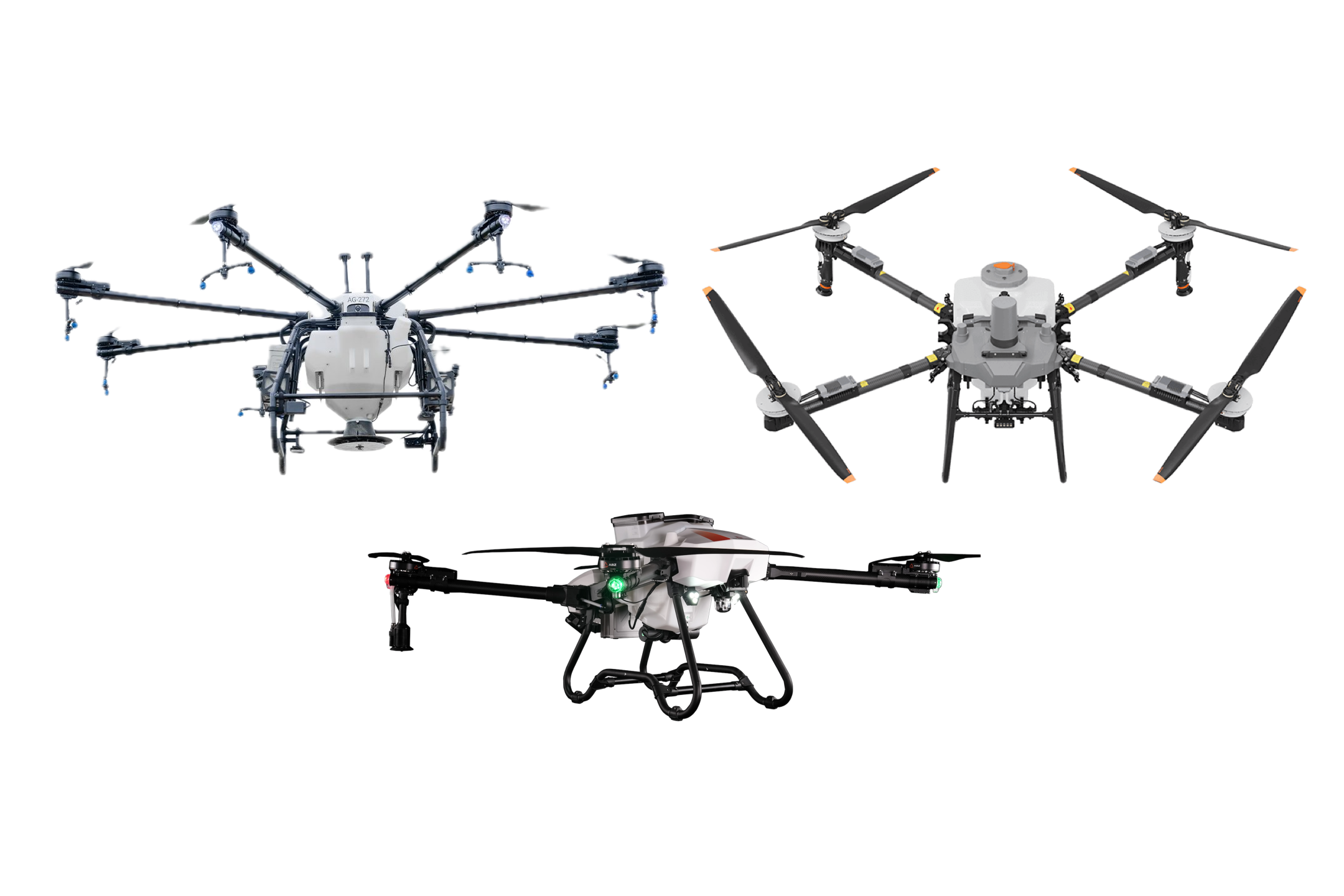
Choosing the Right Drone for Your Farm: A Guide for Precision Agriculture
As a farmer, you know that every tool on your operation needs to pull its weight—drones are no exception. Whether you’re scouting crops for pests, mapping fields for irrigation, or spraying with precision, selecting the right drone can boost efficiency, cut costs, and improve yields. Here we have outlined the key factors to consider when choosing a drone for your agricultural needs. Drawing from academic research by leading institutions like NC State University, IEEE, Ohio State University, and Utah State University, this guide will help you make an informed decision tailored to your farm’s unique demands.
1. Match Technical Specs to Your Farm’s Needs
The foundation of any drone purchase starts with its technical capabilities. Different tasks—spraying orchards, monitoring row crops, or mapping expansive fields—require specific drone types, such as multirotor for precision tasks or fixed-wing for broad coverage.
- Payload Capacity: For spraying, you’ll need a drone that can handle 4–15 gallons of liquid without sacrificing stability, ideal for small to medium fields. For monitoring, ensure the drone supports advanced sensors like multispectral or thermal cameras for detailed crop health data [12, 10, 11].
- Flight Time and Endurance: Multirotor drones typically offer 5–30 minutes per battery, perfect for quick tasks like spot spraying. Fixed-wing drones, designed for mapping large areas, can fly over an hour, reducing downtime from battery swaps [11, 12].
- Range and Speed: Look for a range of several kilometers for fixed-wing drones and speeds of 10–30 mph to balance coverage and precision, especially for spraying without excessive drift [11, 12].
- Precision Features: For tasks like variable-rate spraying, prioritize drones with RTK GPS for centimeter-level accuracy and a spraying altitude of 7–12 feet to minimize drift, with a swath width of 30–35 feet for efficiency [12].
2. Prioritize Sensor and Data Capabilities
Drones are only as good as the data they collect. Whether you’re analyzing crop stress or mapping irrigation needs, sensor compatibility is critical.
- Sensor Types: Choose drones that support RGB, multispectral, hyperspectral, or thermal sensors based on your goals. For example, multispectral sensors calculate NDVI for crop health, while thermal sensors help map irrigation issues [10, 11]. Ensure the ground sampling distance (GSD) suits your needs—finer for young plants, coarser for mature crops to manage data size [10].
- Data Processing: Look for drones with fast data acquisition and compatibility with software like DJI Go or Pix4D for creating orthomosaics or vegetation indices. Cloud-based processing can handle the 2–4 GB of data per flight, keeping your workflow smooth [10, 11].
3. Focus on Autonomy and Ease of Use
Farming is demanding, and drones should simplify, not complicate, your routine. Autonomy and navigation features are key to seamless operation.
- Navigation and Autonomy: Drones with GPS accuracy, obstacle avoidance, and autonomous flight paths ensure safe, repeatable missions over uneven terrain. User-friendly apps for mission planning, like Pix4D, save time and reduce errors [10, 11].
- Drone Type: Multirotor drones (4–6 rotors) excel at hovering for precise spraying, while fixed-wing models cover large areas for mapping. Hybrid drones offer versatility for mixed tasks, though they’re pricier [10, 12].
4. Ensure Durability for Farm Conditions
Farms are tough environments—dust, wind, and uneven terrain are the norm. Your drone needs to handle these challenges.
- Weather Resistance: Opt for drones that can operate in winds up to 7 mph for spraying or broader conditions for monitoring. Look for IP-rated enclosures to protect against moisture and debris [11, 12].
- Maintenance: Choose models with easy-to-clean nozzles, simple battery management, and readily available replacement parts to minimize downtime during peak seasons [11, 12].
5. Stay Compliant and Safe
Regulatory compliance isn’t optional—failing to meet standards can ground your operation. Safety and ethics matter too.
- Regulations: Ensure the drone complies with FAA Part 107/137, stays under 55 lbs, and adheres to visual line-of-sight rules. For spraying, verify pesticide label compliance. Some projects may restrict drones from certain manufacturers (e.g., specific Chinese models) [10, 12, 13].
- Safety and Privacy: Look for collision avoidance sensors to reduce risks and ensure spraying minimizes applicator exposure. Respect privacy by avoiding flights over populated areas [12, 13].
Making Your Decision
Start by identifying your farm’s primary needs—spraying, monitoring, or both. Then, match drone specs to those tasks while factoring in your budget. For example, a DJI multirotor is reliable for daily spraying, while a fixed-wing drone suits vast acreage mapping. Run a simple net present value (NPV) analysis to project returns over five years, ensuring the drone pays for itself through efficiency gains [13].
With the right drone, you’ll gain actionable insights, save time, and boost yields—all while staying compliant and safe. Ready to choose? Share your farm’s specifics, and we can help narrow down the best models for you.
Sources:
- [10] NC State University research on drone applications in agriculture
- [11] IEEE-affiliated studies on UAV technical specifications and autonomy
- [12] Ohio State University Extension resources on drone spraying and regulations
- [13] Utah State University studies on cost-benefit analysis of drones in precision agriculture